Central Avenue
Jefferson sat at the edge of the West Coast's most vibrant jazz corridor — students walked from class to professional clubs and back.
A Feature Documentary
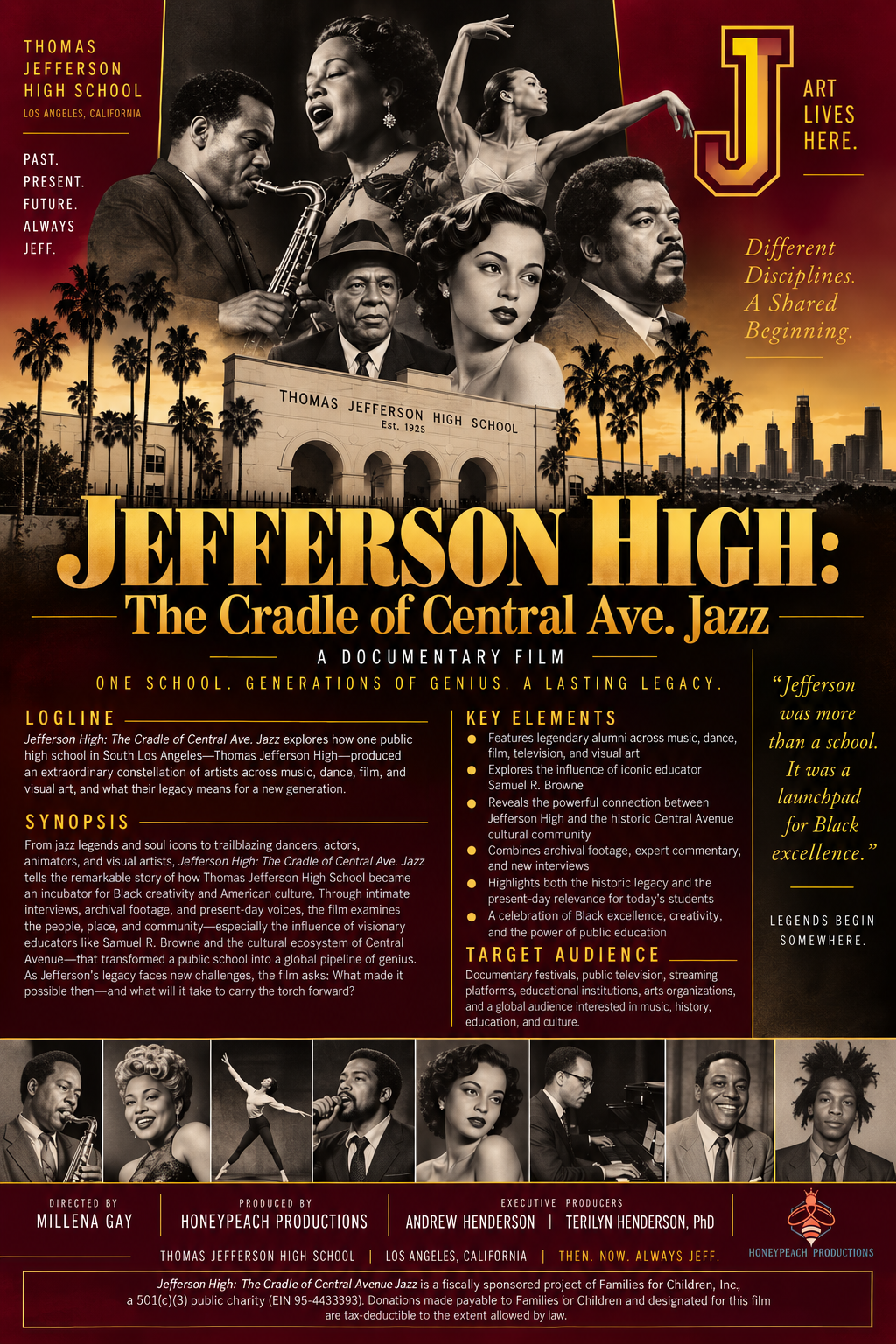
The story of Thomas Jefferson High School — the South Los Angeles classroom that trained more jazz musicians than any other high school in America.
Why This Film, Why Now
Thomas Jefferson High School in South Los Angeles is an American story of what a public school can do. On the edge of Central Avenue, in a neighborhood built by families who left the Jim Crow South, a music program under band director Samuel R. Browne turned ordinary classrooms into a training ground for genius. From that one school came Dexter Gordon, Etta James, Chico Hamilton, Art Farmer, Roy Ayers, Horace Tapscott, Barry White, Alvin Ailey, Dorothy Dandridge, and a generation of others who shaped jazz, blues, dance, and popular music. Their work traveled from the clubs of Central Avenue to concert halls, film screens, and living rooms across the country and around the world. Jefferson High is proof that American culture has often been written not only in elite conservatories, but in public schools, by teachers who believed their students belonged in the national story - and by the young people who proved them right.
Jefferson high school became one of the most important incubators of American jazz and Black entertainment because it sat at the edge of Central Avenue, the West Coast's answer to the Harlem Renaissance in the 1930s through the 1950s. Under music teacher Samuel R. Browne—one of the first Black secondary-school teachers in the Los Angeles system, hired in 1936—the school offered rigorous training in theory, harmony, counterpoint, orchestra, band, and choir, while students walked from campus to clubs such as the Dunbar Hotel, Club Alabam, and Jack's Basket Room to hear and eventually join working professionals. The result was extraordinary: Jefferson is widely credited with producing more jazz musicians and composers than any other high school west of the Mississippi.
The musicians, dancers, and artists who came out of Jefferson High changed American culture. Most of their stories have never been told on film.
The clock on this story is not theoretical. The people who sat in Samuel Browne’s music room, who carried their horns from 41st Street to the after-hours sessions at Jack’s Basket Room, who heard Duke and Ella as neighbors rather than myths, are now in their eighties and nineties, or already gone. What remains is a narrowing window of living memory: a few voices that can still describe the smell of the rehearsal room, the walk down Central Avenue, the moment a teenager realized the clubs were hiring kids from Jefferson. Those memories do not transfer cleanly to books or plaques. They live in the pause before a name, the way a hand shapes an invisible saxophone, the correction of a detail no archive captured. At the same time, the building is still there. Students walk the same Streamline Moderne halls, sit in the same auditorium, and inherit a legend they have mostly heard secondhand. The school that once fed the West Coast’s greatest jazz scene now risks becoming a footnote to its own alumni. A documentary made now can place those fading witnesses in the same frame as the students who still have time to pick up the instruments. It can film the empty lots where the Alabam and the Dunbar lounge stood, then cut to a current Jefferson ensemble learning the school’s book. Wait much longer and the film becomes an elegy assembled only from photographs. Made now, it can still be a conversation between the people who carried the music out and the ones who might carry it back in.
The musicians, educators, and community members who lived this history are in their eighties and nineties. The clubs are gone. The neighborhood has changed. The institutional memory of what Central Avenue and Jefferson High meant to American music — and to the families who built that world — exists almost entirely in the minds of people who are still alive today. This film is an act of preservation. If we do not tell this story now, in their own voices, it will be lost. Not diminished. Not distorted. Lost. The urgency is not dramatic — it is demographic. Every year we wait, we lose another witness, another voice, another thread of the story that cannot be recovered.
The Cradle
"They didn't just play music. They made history."
From one school in South Los Angeles came an extraordinary generation of artists who shaped jazz, blues, dance, and popular music — and left their mark on recordings, film, and stages around the world.
Jefferson sat at the edge of the West Coast's most vibrant jazz corridor — students walked from class to professional clubs and back.
One of the first Black secondary-school teachers in the LA system, Browne built a program in theory, harmony, orchestra, band, and choir that rivaled any conservatory.
The eyewitnesses are in their eighties and nineties. Their stories — and the full scope of Jefferson's contribution — have never been captured on film.
The Film
Jazz at Jeff tells the story in four movements — from the founding of a neighborhood to the legacy that lives on.
The Great Migration brings Black families from the Jim Crow South to South Los Angeles. Central Avenue becomes the West Coast Harlem.
Samuel R. Browne joins Jefferson High in 1936. His music program becomes a pipeline from classroom to professional stage.
A generation of students becomes a generation of masters. Their recordings, performances, and compositions travel the world.
What Jefferson built — and what was lost when Central Avenue declined — and why it matters to American culture today.
Similar Films
Jazz at Jeff joins a tradition of music documentaries that have found large, passionate audiences across theatrical, streaming, and educational markets.
Sundance Grand Jury Prize. Hulu. $1M+ theatrical gross.
Concert film documenting the 1972 Watts Summer Festival — a landmark of Black cultural documentary filmmaking with enduring audience and critical legacy.
PBS American Masters. Wide festival run.
Oscar nominated. $7M+ worldwide theatrical.
"The market for music documentaries — especially those rooted in African American cultural history — has never been stronger."
The Filmmakers
Jazz at Jeff is produced by a team with deep roots in documentary, community health, and the history of South Los Angeles.
Executive Producer
Andrew Henderson is the Executive Director of Families for Children-FFC Spiritual and Behavioral Health Center. He leads the agency's operations, stewardship, and community presence, guiding FFC from its origins as a foster and family resource agency into an accredited nonprofit treating addiction and mental health.
Executive Producer
Dr. Terilyn Henderson brings expertise in behavioral health, community development, and organizational leadership. She has been instrumental in shaping FFC's mission and its commitment to lifting spirits and changing lives in South Los Angeles.
"This is a story of the tragic and the heroic — and how resilience in the face of racism and poverty created magnificence."
Director / Producer
An award-winning producer, director, actress, and entrepreneur whose career spans nearly three decades. A native of Upper Marlboro, Maryland,Millena began in television on One Life to Live and went on to All My Children, The Guiding Light, General Hospital, and The Young and the Restless. She then wrote, produced, and hosted talk shows before moving behind the camera, completing UCLA Extension’s Producing and Entertainment Studies Program and its Directing Certification for Film and Television, both with honors. Through Honey Peach Productions she develops narrative and documentary projects, and she recently launched Life Lens Legal Documentaries, which produces settlement and mediation documentaries for plaintiff-side attorneys.
"Excellence is not an option — it is an expectation and a way of life."
Your support matters
Supporting Jazz at Jeff means investing in the preservation of a vital chapter of American jazz history and education — one that is at genuine risk of being forgotten. The musicians, teachers, and community members who built this legacy are aging. Their stories, their memories, and their firsthand accounts of what happened on Central Avenue and inside Jefferson High School exist nowhere else. This documentary will capture those voices, create an educational resource for future generations, and ensure that the contribution of a Black public school in South Los Angeles to American culture is never erased from the record.
Jazz at Jeff is fiscally sponsored by FFC-Spiritual and Behavioral Health Center. All contributions are tax deductible.FFC is a 501(c)3 organization. Tax ID# 95-4433393For more information on how to financially support the documentary please email: andrew@familiesforchildren.orgProject Pitch Deck Link